Meta MCP: The Complete Guide (2026) · MarketingRoutine Guide
Meta MCP: The Complete Guide (2026)
Last verified:
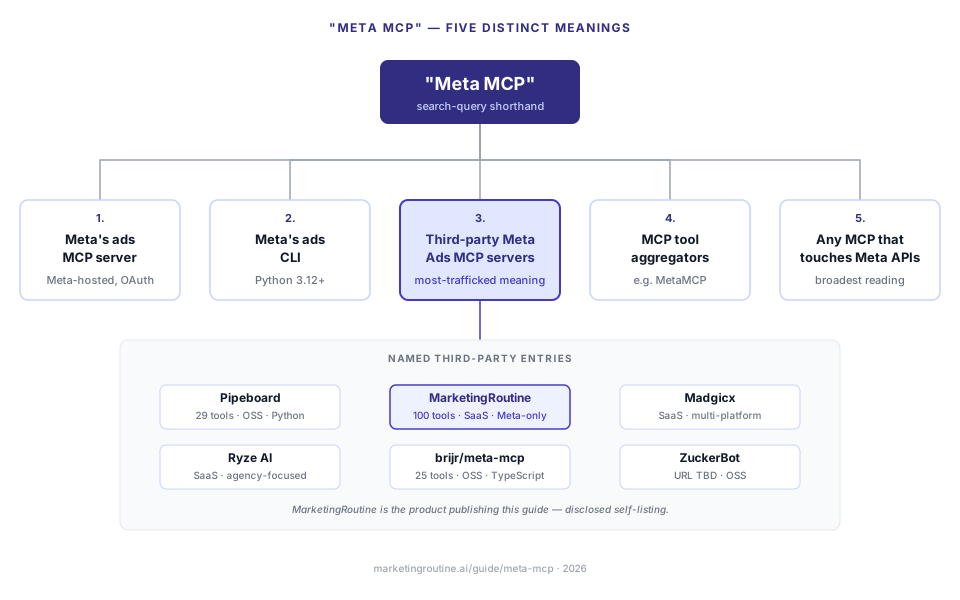
The five distinct meanings of 'Meta MCP'. Meaning #3 (third-party Meta Ads MCP servers) is the most-trafficked search intent and the practical product-decision surface for most marketers.
What does "Meta MCP" actually mean?
Marketers searching for "Meta MCP" typically mean one of five distinct things, and most overview posts conflate at least two of them. The disambiguation matters because the install path, capability surface, and risk profile differ in every case.
1. Meta's own ads MCP server. Meta announced "Meta ads AI connectors"↗ on April 29, 2026 — an open beta that ships two artifacts: a Meta-hosted MCP server and a separate command-line interface. Meta does not market either as "Meta Official MCP," but the search query exists and this is what most people now mean by it.
2. Meta's ads CLI. The other half of the April 2026 launch is a CLI binary, not an MCP server. The two products share the underlying Meta Marketing API but use different transports. Several recent overview posts conflate them; the covers the distinction.
3. Third-party Meta Ads MCP servers. Software that wraps the Meta Marketing API and exposes it as MCP tools to AI clients like Claude or ChatGPT. The category predates Meta's own server by roughly a year. Major entries include Pipeboard↗ (open-source, self-host), MarketingRoutine (commercial SaaS, Meta-only), Madgicx↗ (commercial SaaS, multi-platform), Ryze AI↗ (commercial SaaS, multi-tenant), brijr/meta-mcp↗, and ZuckerBot. Each takes a different position on hosting, pricing, agent permissions, and platform breadth.
4. MCP tool aggregators. Software like MetaMCP that fronts multiple MCP servers behind a single endpoint. The "Meta" in MetaMCP refers to meta (above/across), not Meta Platforms — but the naming collision creates real search confusion. The MetaMCP aggregator page covers when an aggregator is the right primitive.
5. Any MCP that touches Meta APIs. The broadest reading. In practice, almost no one means this — but it appears in academic discussion of the MCP ecosystem and is worth naming so the disambiguation is complete.
The rest of this guide treats meanings 1, 3, and 4 as the practical surface area. Meanings 2 and 5 get full coverage in the linked deep-dives but rarely drive product decisions on their own.
What is Meta's ads MCP server?
Meta's ads MCP server is the Meta-hosted half of "Meta ads AI connectors," announced on April 29, 2026↗. It exposes four capability areas: comprehensive reporting on campaign performance, campaign management (create and edit ads, ad sets, and campaigns via natural language), catalog management for product feeds, and signal diagnostics for tracking health.
The setup distinguishes it from third-party servers. There is no Developer App to register, no OAuth flow to manage manually, and no API setup. Authentication routes through Meta Business OAuth directly, which the launch announcement frames as suitable for "businesses of all sizes" with "no developer credentials, API setup, or coding."
The server is currently in open beta with pricing unannounced for general availability. It is not open-source — Meta hosts the server, and the source is not published. The companion CLI is a separate binary; the setup guide covers installing the MCP server inside Claude Desktop and the CLI for terminal-based workflows.
What the announcement does not cover, and what working marketers will want to verify before committing: rate-limit behavior under high concurrent load, data residency for logged requests, deprecation cadence for endpoints, and the long-term pricing trajectory once open beta ends. These are non-trivial in production. The Meta Official MCP page revisits them with hands-on testing notes once available.
For the SMB or mid-market marketer who wants a connector and is not building a product on top of it, Meta's own server is now the lowest-friction starting point. For agencies managing multiple clients, for engineering teams building internal tools, and for use cases where the workflow around creative operations matters more than raw connectivity, third-party products can still be the right layer. The next sections cover each in turn.
What is Meta's ads CLI (and why isn't it the same)?
The other half of Meta's April 2026 connectors launch↗ is the Meta ads CLI — a separate Python-based command-line binary, not an MCP server. The two artifacts share the underlying Meta Marketing API but expose it through different transports. Several recent overview posts conflate them; the deeper coverage in Meta Official MCP keeps them straight.
The CLI requires Python 3.12+ and pip or uv↗ and exposes the same surface areas as the MCP server: campaigns, ad sets, ads, creatives, performance insights (spend, impressions, CTR, ROAS), catalogs, product items, product sets, and conversion pixels. The use cases Meta highlights are different in shape, though: development workflows, CI/CD pipelines, interactive shell use, automated task execution, and shell-based AI agent integration.
The shorthand to keep them straight: the MCP server is for AI clients that speak MCP natively (Claude Desktop, Cursor, Continue, ChatGPT with MCP support). The CLI is for terminal sessions, scripts, and pipelines where a shell command is the right primitive. Meta's own framing on the developer blog is the same: developers and AI agents working with the Meta Marketing API can now create, edit, and analyze campaigns directly from the command line, without writing custom code.
In practice, marketers who want to use Claude or ChatGPT to manage their Meta ads will install the MCP server. Engineering teams or agencies wiring Meta operations into existing infrastructure will reach for the CLI. Many will install both. The Meta MCP setup guide covers each path step-by-step.
What is a third-party Meta Ads MCP server?
A third-party Meta Ads MCP server is software — usually open-source on GitHub or commercial SaaS — that wraps the Meta Marketing API and exposes its operations as MCP tools to AI clients. The category predates Meta's own server by roughly a year and remains relevant for use cases Meta has not addressed: self-host with full code audit, multi-tenant agency operations, broader advertising-platform consolidation, and workflow layers that are too specific for a global open beta.
Disclosure before the named list: MarketingRoutine is the product the team publishing this guide works on. It appears below alongside competitors. The rubric in the alternatives page applies identically to all products, including MarketingRoutine, and the comparison pages name where it loses.
Pipeboard↗ is the most-starred open-source entry — 840 stars, 200 forks, 29 MCP tools, Python, with v1.0.93 shipped April 30, 2026 (one day after Meta's own launch). Licensed under Business Source License 1.1, converting to Apache 2.0 on January 1, 2029 — technically "source-available" rather than classic open-source until then, with commercial-use terms worth reading before deploying inside a paid product. Ships both as a hosted endpoint at mcp.pipeboard.co/meta-ads-mcp and as a local install via pip or the Pipeboard CLI (brew install pipeboard-co/tap/pipeboard). Pipeboard also publishes separate non-Meta ads MCPs, making the broader Pipeboard family multi-platform via independent servers.
MarketingRoutine is a commercial SaaS focused on Meta and Instagram only. The current V2.1 beta is intentionally narrower than the older vision: onboarding, workspace dashboard, MCP endpoint, bulk creative upload, and creative performance with thumbnails. SaaS-only — no self-host. Meta-only — no broader ad-network bundle. The honest tradeoff: a smaller workflow layer around repeated Meta operator work versus the breadth and code-audit options of self-host alternatives. The Meta Official vs MarketingRoutine page covers the head-to-head with Meta's beta server.
Madgicx↗ is a commercial multi-platform suite that bundles Meta with other ad channels in a single MCP-capable product, oriented at mid-market and agency operations. It predates the MCP era and added MCP capabilities on top of an existing optimization platform, which means broader scope but a different product shape — closer to a managed optimization service with MCP access than an MCP-native server.
Ryze AI↗ is a newer commercial entrant focused on agencies managing multiple Meta clients. The differentiating positioning is around agency operations — creative-fatigue handling, Business Manager auto-discovery, white-label client portals, and per-client token isolation — rather than raw API breadth. Ryze published a detailed competitive overview of Meta's launch on April 30, 2026; the analysis is technically thoughtful but vendor-published, so factual claims about non-Ryze products in their coverage are best independently verified.
brijr/meta-mcp↗ is a smaller open-source TypeScript implementation — 25 tools, 160 stars, 65 forks, MIT license, with both npm install -g and one-click Vercel deployment options. Useful for teams who want a TypeScript codebase to fork or who already deploy on Vercel. Smaller surface area than Pipeboard but a clean reference implementation for self-host engineering teams.
ZuckerBot appears in some MCP directory listings as a community-maintained Meta Ads MCP, but the canonical repository URL has not been verified for this guide as of publication. The alternatives page will list a verified link once available; readers who run ZuckerBot in production are invited to email the correction so it lands in the next changelog entry.
Each of these takes a different position on hosting model, licensing, permission model, platform breadth, and pricing. The decision tree later in this guide covers which use case maps to which choice.
What is an MCP tool aggregator?
An MCP tool aggregator is software that fronts multiple MCP servers behind a single endpoint, so an AI client connects once and gets a merged tool catalog drawn from many backends. The most-cited example is MetaMCP — and the naming collision is the point: the "Meta" in MetaMCP refers to meta (above, across), not to Meta Platforms. Search results conflate the two, which is part of why this disambiguation page exists.
A marketer rarely wants an aggregator on its own. The use case kicks in when a team is running several MCP servers — Meta Ads plus other business systems — and wants a single auth surface, unified rate limiting, observability, or per-tool ACL controls. Aggregators add latency and an extra failure mode in exchange for those operational properties.
For a single Meta Ads MCP — Meta's own server, Pipeboard, MarketingRoutine, Madgicx, or any other — an aggregator is overhead, not value. The right reach for an aggregator is when the operational complexity of multiple MCPs in production justifies a control plane.
The MetaMCP aggregator deep-dive covers the deployment architecture, when the abstraction earns its complexity, and how it interacts with the third-party Meta Ads MCPs above.
Which Meta MCP should you use?
The right choice depends less on which product is "best" and more on which constraint is binding. Self-host versus SaaS, Meta-only versus multi-platform, raw connector versus workflow layer — each cuts differently. The decision tree below covers the most common branches.
Which Meta MCP fits your use case?
You want the lowest-friction setup with no developer credentials. → Meta's own ads MCP server. Open beta since April 29, 2026. No Developer App, no OAuth flow to manage, free during beta.
You need to self-host with full code audit. → Pipeboard or brijr/meta-mcp. Pipeboard: 29 tools, Python, BSL 1.1 (becomes Apache 2.0 in 2029). brijr/meta-mcp: 25 tools, TypeScript, MIT, smaller scope.
You need multi-platform coverage in one product. → Madgicx-style commercial suites. The tradeoff is broader platform scope with a different product shape.
You're an SMB or solo marketer running Meta-only with creative upload and performance workflow needs. → MarketingRoutine. Commercial SaaS. V2.1 focuses on onboarding, workspace dashboard, MCP endpoint, bulk creative upload, and creative performance.
You're an agency managing multiple Meta clients with white-label or per-tenant isolation needs. → Ryze AI or MarketingRoutine. Ryze leans agency-first with auto-discovery and white-label portals. MarketingRoutine multi-tenancy is production-ready for smaller agency books.
The branches above are not mutually exclusive — many marketers will land in two or three at once and weight their constraints. Two practical observations from running this evaluation across real production setups:
Constraint binding usually goes in this order: licensing (open-source mandate vs commercial OK) → hosting (self-host required vs SaaS OK) → platform scope (Meta-only vs multi-platform) → workflow needs (creative upload, workspace context, agency multi-tenancy). Each filter cuts the field in half. Most teams resolve the first three filters quickly and the workflow needs end up being the deciding factor.
Meta's own server is now the default for "I just want to manage Meta ads with Claude." That answer was different two months ago — third-party servers were the only option. The launch of Meta's connectors collapsed the simple-case decision. The third-party servers are now justified by a specific need Meta hasn't addressed, not by being the only path.
How do I evaluate a Meta MCP?
The comparison pages score each evaluated product against a 13-criterion rubric. The full rubric and per-product scores live there; the categories are previewed below so the framework is portable to any future entrant.
Deployment and licensing. Hosting model (self-host, SaaS, hybrid), license type (classic open-source like MIT or Apache, source-available like BSL, or proprietary commercial), and code transparency. Critical for compliance-bound buyers and any organization that needs to audit what's running.
Capability surface. Tool count, API coverage breadth (campaigns, ad sets, ads, creatives, audiences, insights, comments, catalogs), and whether the server is MCP-native or a wrapper bolted onto an existing optimization platform. Tool count alone is a thin metric; coverage breadth matters more for whether the specific workflow is supported.
Operational properties. Workspace context, multi-tenancy support (per-client isolation, separate token scoping), rate-limit governance, and observability into tool actions. These are what separate "an API wrapper" from "a tool deployable in production."
Pricing and risk. Pricing model (free, free-tier-with-paid, flat SaaS, usage-based), long-term sustainability, security posture (OAuth-based vs browser-automation, account-flag risk), and safety controls on destructive operations like pauses, deletes, and budget changes.
The honest read on rubric scoring: every product loses on at least three criteria. The question is not which product wins overall but which losses are tolerable for the specific use case. The comparison pages name where each product loses, including MarketingRoutine, so the tradeoffs are visible rather than hidden.
The fifth meaning: any MCP that touches Meta APIs
The broadest reading of "Meta MCP" is any MCP server that calls Meta APIs at any point. Under that reading, every product covered above qualifies, and so does any general-purpose MCP that happens to include Meta integration as one of many capabilities — for example, multi-platform marketing MCPs that bundle Meta alongside other ad networks without specializing in any of them.
In practice this meaning is mostly academic. Marketers searching for "Meta MCP" almost never mean it. It appears in MCP-ecosystem discussion ("which MCPs work with Meta APIs?") and in academic surveys, but rarely drives a product decision. The four practical meanings above (Meta's own server, Meta's CLI, third-party Meta-specific servers, MCP aggregators) cover essentially all the real-world cases.
Naming this meaning still matters. Disambiguation is only as good as its completeness — leaving the broad reading unmentioned would let confusion slip back in.
The FAQ below collects the questions that come up most often when people search "Meta MCP." Comparison-specific answers live on the deep-dive pages linked throughout.